The world of end user computing for VMware, its partners, and its customers is currently in a state of transition. Not only from a commercial perspective, but also when it comes to the technology itself.
On the 22nd of November 2023, Broadcom completed its $69 billion acquisition of VMware. Not long after the deal closed, Broadcom announced that it was going to divest (sell off) the end user computing business unit effectively putting the for sale up on the front lawn to any interested parties who wanted to give Horizon product portfolio and Workspace ONE a new home.
After much speculation about who the new owners would be, would it be Microsoft, Citrix, or maybe even HP as they had recently acquired Teradici, American investment company KKR announced that it would be acquiring the EUC business unit for close on $4 billion. And so, begins the next chapter of the continuing story.
Rumour and speculation didn’t stop there with people trying to guess what would happen next and what would the new company be called which in reality became one of the worst kept secrets as Broadcom themselves, as part of the transition, started to post links to websites that clearly had the name of the new company in them! So, the secret was out if you looked not too hard as the name had been hiding in plain sight.
Finally on 25th April 2024, in a VMware end user computing blog, the new name for the VMware end user computing business unit was officially announced as Omnissa, complete with a link to the new holding page for the Omnissa web site. One can only assume that the announcement was made to end the speculation and also because most people already knew anyway.
Wind the clock forwards a week and the Omnissa website went live showing the world for the first time the new logo and new branding.
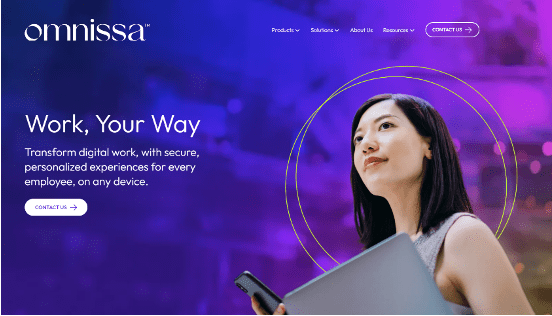
The website showcases Horizon, Workspace ONE platform solutions, App Volumes and Dynamic Environment Manager (DEM).
As for Workstation Pro and Fusion, they remain part of the Broadcom product portfolio.
At the same time as the Omnissa launch, a number of the VMware online pages such as downloads and support have all moved the Broadcom website under the Broadcom URL and domain name.
So now we know and there endeth the story, right? Not yet. For a start the deal hasn’t officially closed and won’t do so until later in 2024.
For customers and partners there is still a lot to think about and in the words of the Clash song, “Should I stay or should I go!” do they need to think about migrating away from the Horizon platform?
One of the questions around why a potential move is in consideration is around the vSphere licensing. Horizon was bundled with vSphere for Desktop that allowed you to deploy vSphere infrastructure to support your Horizon platform. As vSphere is a Broadcom product how is that going to work especially as Horizon integrates tightly into the vSphere platform with technology features such as Instant Clones.
This question has now been answered by a recent email to customers.
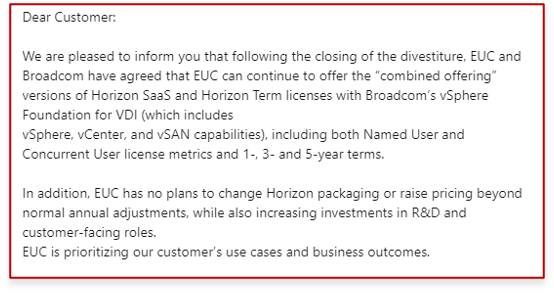
The email (above) states that an agreement has been reached that enables customer to continue using Broadcom’s vSphere Foundation for VDI (vSphere and vSAN products) when using Horizon SaaS and Horizon Term (on-premises) licenses.
With the question of continued Broadcom hypervisor support now answered, or at least answered for now, there is another more burning issues that requires consideration and action which has nothing to do with the divestiture of the VMware EUC business unit. What I am talking about now is a fundamental shift in the Horizon architecture as it stands today and what customers need to think about for moving forward.
Long before the acquisition and divesture conversations, VMware had announced the end of life for the PCoIP display protocol used in Horizon. PCoIP is a display protocol solution provided by a third-party vendor, Teradici, which is now wholly owned by HP.
PCoIP has been the primary display protocol used by VMware Horizon for delivering virtual desktops and applications to a zero client device that runs just the Teradici T2 chipset and has no local operating system installed making it the default choice for secure environments. However, since 2013, VMware has been delivering their own home-grown protocol called Blast. Over time Blast has matured to point where today it delivers significantly more features within a VMware environment than PCoIP currently does.
So, what does “end of life” mean exactly?
PCoIP will remain an option for Horizon users up until the end of 2025, at which point it will no longer be available as a protocol choice in any newer versions of the Horizon software that get released after that date. However, it will still be supported for three years after that date, so customers will get support up until the end of 2028 (3 years from the date on the last PCoIP-based Horizon Agent and Horizon Client being released).
With this in mind what do customers need to know about migrating from PCoIP to Blast?
For those that already have experience of the Horizon solution may say that it is just a case of reconfiguring desktop pools to use Blast instead of PCoIP. But is it really as simple and straightforward as that?
Obviously, you need to test the new protocol. How does it perform with your network and any particular low latency requirements users may have, plus you will need to configure the policies that manage and control protocol settings. But this is the least of your worries. If you are using PCoIP, then you will likely also be using Tera2 chipset-based zero clients.
The Blast protocol will not work with zero client devices!
Zero clients don’t have a local OS or local storage are based on the Teradici Tera2 chipset and therefore only work with the PCoIP protocol. This means you will need to swap out your zero clients and replace them with thin clients or a device which runs an OS that does support the Blast protocol and you will need to do this before the end of 2028.
One of the reasons PCoIP and zero clients were such a hit was their secure way of working. Not only by using an encrypted protocol but due to there being no data stored on the client device.
There are potential options to continue to use PCoIP with Horizon if that is a requirement. There is a tech preview that HP are working on for an HP Anyware PCoIP plug-in for Horizon, based on the latest PCoIP Ultra version and using HP solutions in the form of HP Anyware and HP Trusted Zero Clients. But what you need to be aware of with the HP solution and their Trusted Zero Clients is that these clients are not zero clients as we know them. They are basically thin clients as they have a local OS.
This version of PCoIP is a software-based client and will likely not be supported using the T2 chipset-based zero clients, even though technically it may work. You will still need thin clients to run this. This, if you have zero clients deployed, is not really an option plus there is also the added complexity of adding third-party plug-ins not to mention there is likely an additional cost for the software plug-in, and you still need to swap out the physical client devices. This is only really an option to consider if you really need or want to continue using the PCoIP protocol, but just to add, one of the core reasons for PCoIP deployment was the security delivered by the zero client devices and reading between the lines, these clients have reached the end of their natural life.
The upshot of it all, and if you want to continue using VMware Horizon and you are currently using PCoIP, is to move to Blast and then swap out the client devices.
So far, we have discussed the move from PCoIP to Blast and the swapping out of existing zero client devices, however you could look to replace the entire VMware Horizon platform instead and migrate to a different vendors solution. This is a radical option and still doesn’t solve the client device issue as another vendors solution won’t be using PCoIP either and therefore you still have to replace the zero clients. Plus, you then have to design and implement a new vendors solution. Not an easy task as you would need to reskill on the new platform plus the potential disruption to the workforce during the migration process. That’s before you look at the cost side of things. You might save costs on licensing of a new solution, but what about the overall bigger picture costs?
Maybe consider a cloud-based solution that uses Horizon, or if platform migration is an option, then there is always Microsoft Azure Virtual desktop (AVD). Now is a good time as you are also likely looking at the migration from Windows 10 to Windows 11.
So, what is the answer? What direction should customers take and what should they do?
To be honest there are just a couple of options to consider. The first, which is not really an option in my book, is to do nothing. You can continue to run without support and see it through to the bitter end when support finally runs out. Or go beyond those dates. As I said, not really a viable option.
You need to start that migration plan today if you haven’t already started, or at least start mapping out a project plan. Time is running out. Start by looking at the thin client options available and maybe procure a couple of units for evaluation to see how they perform in a test group that uses the Blast protocol.
This is where Spartan can help you. Our highly-skilled consultants have years of experience with VMware and the EUC product portfolio, having designed and implemented them in some of the most demanding environments and are on-hand to help navigate you through your options as well as provide the consultancy services to take you through the full project lifecycle.